Affordability
Household economics belong at the center of the ownership conversation.

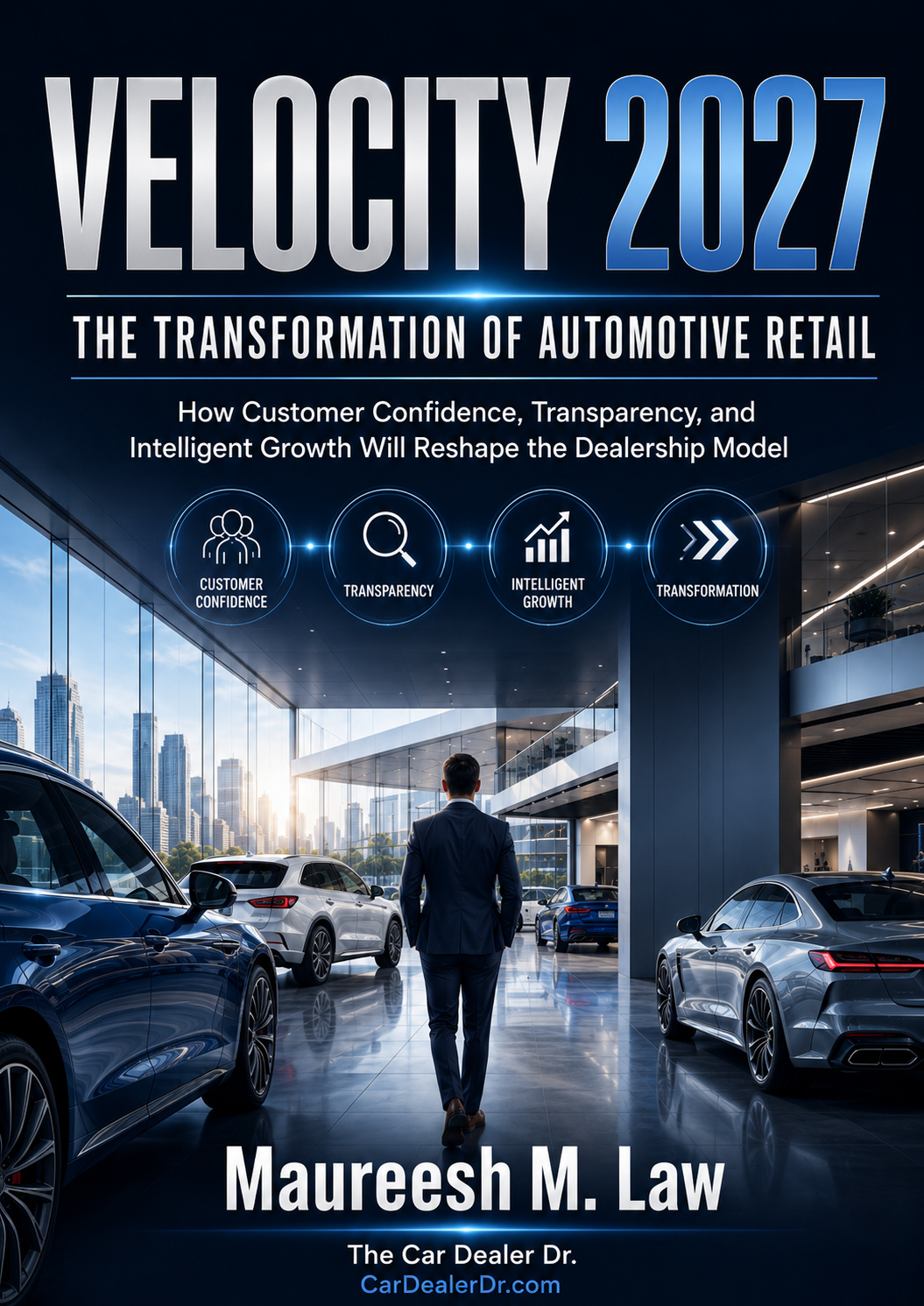
The Transformation of Automotive Retail
How Customer Confidence, Transparency, and Intelligent Growth Will Reshape the Dealership Model
Seven themes from the manuscript's journey—from an industry on trial to the Confidence Economy.
Household economics belong at the center of the ownership conversation.
Confidence depends on support throughout the ownership experience.
Customers need clarity about long-term commitments and financial exposure.
Consistent expectations make complex decisions easier to understand.
A connected journey preserves trust beyond a digital transaction.
Better context and accountable human judgment matter more than disconnected tools.
Customer confidence is an enterprise responsibility.
From the industry's reckoning to the leadership of the Confidence Economy.
Part I · Chapters 1–6
A closer look at the contradictions customers can now see—and the leadership responsibility to rebuild confidence in automotive retail.
Implement this in your dealershipVehicle costs and household pressures are changing the ownership decision. Explore why affordability belongs at the center of retail strategy.
Implement this in your dealershipMore sophisticated vehicles bring new ownership uncertainties. Discover why confidence depends on support and communication as much as the product.
Implement this in your dealershipAs customers reconsider how and whether to own, dealerships face a different value conversation—one shaped by flexibility, risk, and lasting usefulness.
Implement this in your dealershipBehind a hesitant purchase can be a deeper fear of financial exposure. Understand the uncertainty customers carry into a long-term commitment.
Implement this in your dealershipInherited processes can amplify the very doubts leaders want to resolve. Reconsider the habits that make a customer journey harder to trust.
Implement this in your dealershipPart II · Chapters 7–10
Information alone does not create certainty. Explore the gap between what customers know and what they need to feel confident moving forward.
Implement this in your dealershipClarity can be more than a pricing promise. See transparency as a leadership discipline that connects customer expectations and dealership execution.
Implement this in your dealershipNot all profit builds the same future. Consider the difference between short-term extraction and the enduring value of a trusted relationship.
Implement this in your dealershipGrowth extends across the ownership lifecycle. Explore affordability as a lifecycle discipline that connects today's decision with tomorrow's customer relationship.
Implement this in your dealershipPart III · Chapters 11–14
Move from a growth thesis to leadership choices. Consider how a confidence-centered framework changes the priorities inside a dealership.
Implement this in your dealershipThe next ownership conversation starts before a customer returns to the market. Reframe trade timing around an ongoing relationship rather than a fresh lead.
Implement this in your dealershipA sale is one moment in a longer relationship. Explore why lasting customer value requires an enterprise perspective beyond the transaction.
Implement this in your dealershipService is where ownership confidence is tested repeatedly. Consider fixed operations as a foundation for retention, relationship value, and future growth.
Implement this in your dealershipPart IV · Chapters 15–18
Frictionless retail goes beyond the digital transaction. Explore the continuity and reassurance customers need throughout the entire ownership experience.
Implement this in your dealershipA more responsible first pencil starts with better intelligence. Consider how financial clarity and customer-fit judgment can reshape the affordability conversation.
Implement this in your dealershipEvery restart can interrupt trust. Imagine a dealership journey that preserves customer context while bringing the right expertise into the conversation.
Implement this in your dealershipThe physical store is no longer the boundary of the relationship. Explore how dealership guidance can meet customers wherever their decisions happen.
Implement this in your dealershipPart V · Chapters 19–21
Technology matters most when it supports a coherent operation. Consider the alignment of leadership, customer experience, and accountability behind a future-ready dealership.
Implement this in your dealershipScale creates both opportunity and distance. Examine why a larger footprint must still earn the local confidence on which retail value depends.
Implement this in your dealershipAI belongs inside an accountable operating model, not a collection of disconnected tools. Explore the relationship between intelligence, context, and human judgment.
Implement this in your dealershipPart VI · Chapters 22–29
A strategic view of the forces reshaping retail, ownership, and leadership. Consider what an adaptive dealership must be prepared to become.
Implement this in your dealershipFinancial clarity is the next currency. Explore why the ability to make complex ownership decisions understandable can become a defining economic advantage.
Implement this in your dealershipConfidence is a leadership obligation, not simply a customer-facing message. Consider the choices that make trust part of an organization's daily decisions.
Implement this in your dealershipLook ahead through the lens of enterprise confidence. Explore how leaders can think about the relationship between trust, resilience, and future value.
Implement this in your dealershipAn executive perspective on translating confidence into organizational direction. Consider how leadership priorities can support a more coherent enterprise.
Implement this in your dealershipExplore the intelligence themes connecting dealership insight and leadership judgment. A look at how clearer context can inform a more confident operation.
Implement this in your dealershipGive transformation a focused horizon. Explore a leadership blueprint for turning the book's themes into purposeful priorities without losing sight of the customer.
Implement this in your dealershipThe closing invitation to lead with clarity, responsibility, and conviction. Consider what it means to build a dealership worthy of its customers' confidence.
Implement this in your dealershipVelocity 2027 gives dealership leaders a practical architecture for diagnosing where confidence breaks, where profit leaks, and where future growth can be created.
A diagnostic lens for identifying where uncertainty, distrust, or missing proof prevents customers from moving forward.
Hesitation, repeated objections, and stalled decisions that no incentive seems to fix.
A clearer path to yes, and a customer journey buyers are willing to trust.
A dealership transparency model for turning pricing clarity, communication consistency, and customer trust into competitive advantage.
Pricing contradictions, fee confusion, and inconsistent communication that quietly erode conversion.
Higher confidence, cleaner compliance posture, and more defensible profit.
A lifecycle growth framework for connecting customer confidence to conversion, retention, profitability, and future ownership opportunities.
Sales, service, retention, and marketing operating as disconnected departments instead of one relationship.
A unified growth system that turns trust into repeatable revenue.
A profit-quality model for distinguishing durable relationship value from short-term gross that creates future friction.
Short-term profit that damages long-term customer value and enterprise worth.
Better-quality profit, stronger retention, and more durable enterprise value.
A customer psychology model for understanding what buyers need before making a high-cost, long-term vehicle commitment.
Payment anxiety, negative-equity fear, and the sense of being trapped in a decision.
A safer buying experience that makes customers more willing to move forward.
An affordability strategy for aligning inventory, finance, merchandising, and customer expectations around real household economics.
Payment shock, mismatched inventory, and late-stage deal collapse.
More qualified buyers matched to vehicles they can confidently own.
A retention model for earning the next ownership conversation before the customer returns to the open market.
Lost repeat customers and unnecessary acquisition cost every trade cycle.
Earlier trades, stronger retention, and more predictable future sales.
A fixed-operations model for turning service trust, repair communication, and ownership intelligence into long-term customer value.
Service friction and post-warranty defection that quietly cost the next sale.
Higher retention, stronger customer-pay growth, and more future sales opportunities.
A future-facing management model for aligning dealership leadership, technology, customer experience, and accountability around one operating strategy.
Too many disconnected tools, departments, and customer experiences competing for attention.
A dealership that operates with clarity, continuity, and accountability.
"Information is abundant. Confidence is scarce. The future belongs to the most trusted."
A strategic perspective on retail change, followed by the book's forward-looking confidence thesis.
Velocity 2027 does not predict a softer industry. It predicts a more accountable one. The next decade will be won by organizations that can create confidence at scale.
Dealers will not win only by inventory, price, advertising reach, or brand name. They will win by making complex ownership decisions easier to understand, safer to trust, and easier to repeat.
Pricing clarity will increasingly affect visibility, lead quality, conversion, compliance posture, and customer trust before the customer ever contacts the store. The old model of winning attention through ambiguity will become more expensive than clarity.
Dealers will need payment-fit inventory, realistic financing, lower-risk ownership paths, and better explanations of total cost. Stretching term alone will not solve the household economics customers are facing.
The winners will not be the stores with the most AI tools. They will be the stores with unified data, clear workflows, and accountable human judgment.
Service will no longer be treated only as absorption and repair-order gross. It will become the dealership's strongest retention, repurchase, trust, and household-value engine.
Video, remote F&I, digital documents, payment clarity, home delivery, and guided remote buying will become normal expectations. The physical showroom will still matter, but it will no longer define the boundaries of the customer experience.
Customers will reward stores that preserve context across website, BDC, sales, F&I, delivery, and service. Expertise will still matter, but repeated restarts will become unacceptable.
The next ownership decision will be won before the customer re-enters the public market. Dealers that understand equity, mileage, service behavior, payment position, and ownership timing will reduce acquisition cost and increase repeat sales.
Scale will continue to matter, but scale without trust, accountability, and process coherence will become fragile. The winners will be the groups that can scale local confidence, not merely centralized reporting.
Brand promise, pricing clarity, recall communication, digital retail, and local execution will become inseparable. OEMs will not be able to separate product reputation from the retail experience that delivers it.
Dealerships will expand beyond transactions into ownership guidance, service confidence, mobility options, household relationship management, and lifecycle planning. The dealership becomes more valuable when it remains useful after delivery.
Clarity, proof, continuity, and accountable human judgment will become scarce economic assets as information becomes abundant. The future belongs to dealerships that can make customers feel safer about expensive, complex, long-term decisions.

Maureesh M. Law is the founder of The Car Dealer Dr. and a longtime automotive retail, technology, and dealership growth strategist. Drawing on decades across retail automotive, marketplaces, CRM, enterprise technology, and dealership consulting, Velocity 2027 reflects his belief that the future belongs to the most trusted.
Choose paperback or eBook. Hardcover and audiobook release details are not yet confirmed.
The Velocity 2027 Executive Summary is included as a reader bonus with proof of purchase. This premium executive brief is designed for dealer principals, general managers, OEM leaders, automotive executives, consultants, and leadership teams who want a concentrated overview of the book's 29-chapter, six-part journey, strategic questions, and transformation themes.
Unlike the public preview, the Executive Summary provides a more complete leadership-level view of the Velocity 2027 thesis, including the major forces reshaping automotive retail, the confidence-based growth opportunity, selected operating-system insights, and the strategic questions dealership leaders should be asking now.
Access requires your name, email address, purchase location, and verified proof of purchase. Online submission and delivery are not yet available.
Velocity 2027 is the blueprint. The Car Dealer Dr. helps dealership leaders implement it — turning the ideas in the book into measurable results inside your store.
A diagnostic look at where confidence, margin, and momentum are leaking across your store.
Focused working sessions with leadership to turn the book's ideas into your 2027 operating priorities.
Hands-on engagement built around your rooftops, your market, and your people.
Sharper process, clearer accountability, and a customer experience that converts.
Keep the customers you have and win the ones your competitors are losing.
Practical guidance on applying AI and data where it actually moves results.
Opens CarDealerDr.com in a new tab.
Explore the paperback and eBook. Hardcover release details will be announced once confirmed. Every reader gets the Executive Summary as an included bonus with proof of purchase.